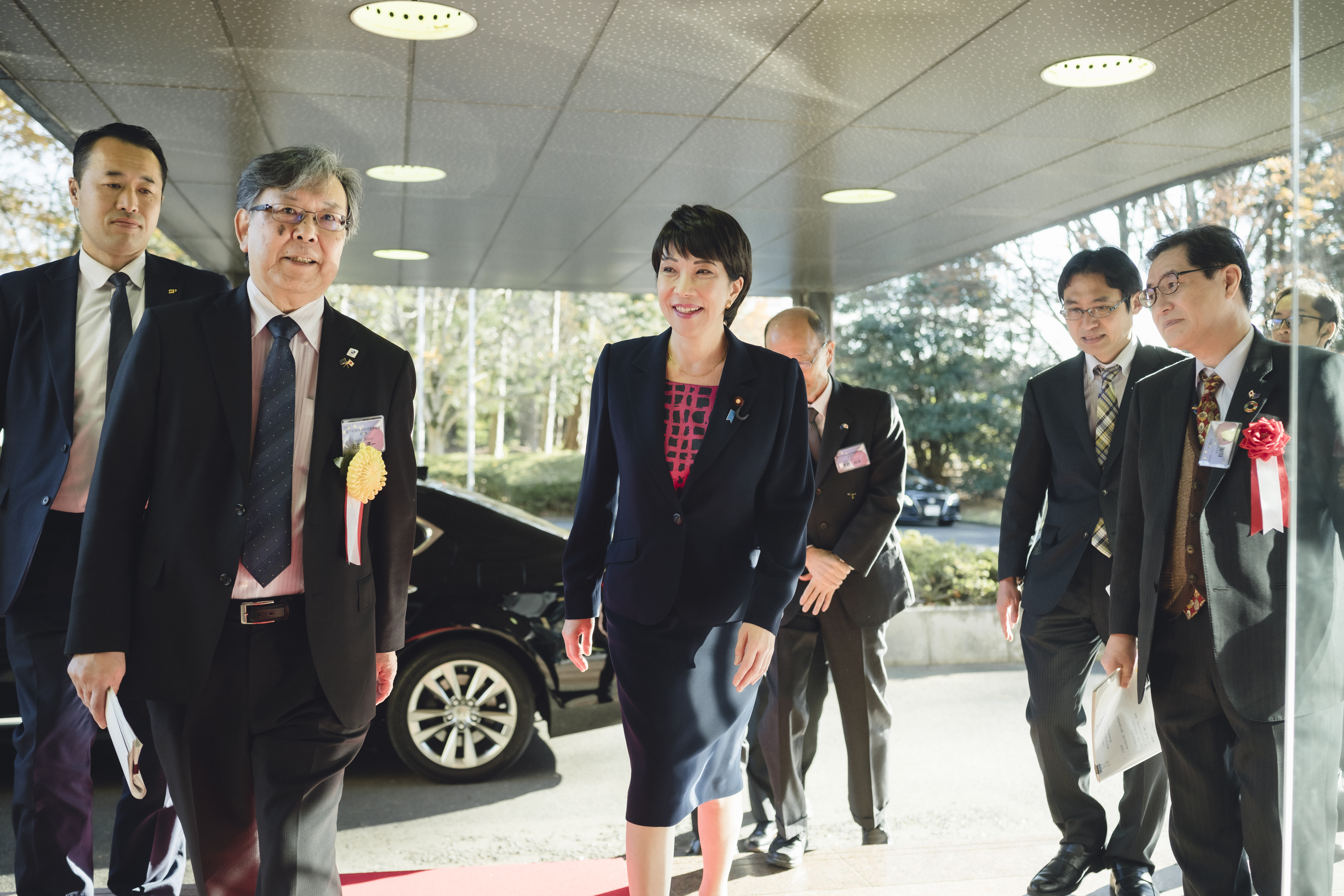
A First for Japan, a Test for the LDP
October 21, 2025, marks the day Japan’s parliament elected Sanae Takaichi as the country’s first woman prime minister. The achievement was made by winning the leadership of the long-ruling Liberal Democrat Party (LDP) and securing backing in the Diet, Japan’s legislative body. Her ascent came after Shigeru Ishiba’s resignation and breaks decades long criticism on gender representation in Japanese politics. Not only is it a historical moment for the country but also a test for a fatigued ruling party navigating tumultuous post-election waters.
Who Is Sanae Takaichi?
Sanae Takaichi is a veteran conservative and protégée of the late Shinzo Abe. She previously served as minister of internal affairs and communications and minister for economic security. This portfolio propelled her into the center of various debates relating to chips, data, and supply chains. Her trademark is unapologetically nationalist: tough rhetoric on defense and history issues, flinty personal style, and an open admiration for Margaret Thatcher, “The Iron Lady”.
Defense First
The Prime Minister is promising bold moves in the defense sector. The previously promised climb in defense spending to 2% of GDP will be attained as early as the end of this fiscal year via a supplementary budget. This comes as both a signal to allies and to meet burden-sharing expectations set by the United States. She also announced that her government would move to revise the three core security documents: the National Security Strategy, National Defense Strategy, and Defense Buildup Program. These alterations will allow for faster and higher investments in counterstrike capabilities, air and missile defenses, munitions stockpiles, cyber and space enablers, and unmanned systems for stronger and efficient responses in modern conflicts.
Economic Security as Growth Scaffolding
At home, Takaichi’s program frames economic security not as a brake on commerce but as a base structure for growth. Her economic policy could be described as appears to be dovish yet market aware. This new framework would tighten control on sensitive technologies and outbound capital where necessary while deepening economic alliances in critical minerals and semiconductors. Moreover, it pledges to use deficit bonds when needed for crisis-management and growth investment. A tight government and Bank of Japan (BOJ) coordination would enable running a high-pressure economy until inflation stabilizes near the 2% goal.
For the average Japanese citizen, the prime minister promises deep changes by focusing on take-home pay. Rather than empty headline wage mandates, she prioritizes take-home pay for the working-age middle class via refundable tax credits built over the medium term and higher basic and employment deductions. Alongside that, she discussed lifting administered prices and pay in the medical field. She has cooled talks of big tax cuts, stresses consolidation remains necessary, and seems compelled to move forward with the BOJ proposed hikes towards the 1% rate.
Reactions At Home and Abroad
Prime Minister Takaichi’s sharpest domestic fault line is her socially conservative views. She opposes same-sex marriage, resists allowing married couples to use separate surnames, and firmly rejects female imperial succession. In urban regions of Japan, these positions are increasingly seen as unfavorable. In her base, they remain markers of consistency.
Symbolically, the breakthrough is real. Substantively, her first cabinet includes only two women out of 19 ministers, a point that led to prompt criticism from her opponents and critics.
Abroad, her history-related positions, including past visits to the controversial Yasukuni Shrine, require careful calibration with China and South Korea to avoid unnecessary friction between regional powers as she pursues firmer security posture.
“The Thatcher of Japan”
The comparison between Sanae Takaichi and Margaret Thatcher is more about style and statecraft than policy. Like the British Iron Lady, Prime Minister Takaichi projects strong resolve, unwavering discipline, and a willingness to court controversy. In her view, national, military, industrial, and technological strength are the prerequisites for prosperity. She appreciates law-and-order messaging and orates about rebuilding a faltering national confidence. But their economic views diverge. Thatcher’s economic policies focused on liberalization and monetary discipline amid rising inflation with a focus on enabling a smaller government and a stronger citizen. Takaichi tackles aging demographics, deflationary psychology, and geopolitical fragmentation using strategic industrial policy and public investment. If “Thatcherism” was “shrink to grow”, “Takaichism” would be “shield to grow”.
The First 100 Days of The Takaichi Government
The first 100 days of any government are a strong preview for their medium to long term successes. In this period, the Japanese government is expected to have a blitz of cabinet directives that push campaign slogans into practical rules. The Ministry of Economy, Trade and Industry and Ministry of Finance could tighten outbound investment screening for chipmaking, AI, and advanced materials. The Ministry of Internal Affairs and Communications and the Personal Information Protection Commission might draft cross-border data-transfer guardrails with security carve-outs. The Cabinet Secretariat’s economic security unit would publish a “next stage” chip plan focusing on packaging, upstream materials, toolmakers, and a talent pipeline through scholarships, apprenticeships subsidies, etc. A new supplementary budget is to be expected by year-end, combining short-term household relief through energy and childcare offsets, refundable tax-credit scaffolding, and industrial policy pertaining to semiconductors, energy resilience, and cyber hardening.
In terms of foreign policy, a Washington reception and summit is to be expected where defense, industry, and tech-standards will be discussed. The government could also concentrate on a G7 and European Union talk about export controls and sanctions governance. Another important meeting would be made with Seoul to preserve the hard-won intelligence and economic cooperation. As for the relationship with Beijing, it is expected that the new government will avoid symbolic history fights that could eclipse the policy rollout while remaining firm on gray-zone pressure, cyber, and the Senkaku Islands dispute between Japan, China, and Taiwan.
Sanae Takaichi’s premiership begins as both milestone and wager: stronger economic security, activist budgets, and tighter alliances to steady growth and deterrence. Whether the ‘Thatcher of Japan’ label sticks will depend less on rhetoric than execution through productivity reforms, credible fiscal paths, and careful diplomacy that raises wages without reawakening regional frictions.